What Is Unjust Vexation? A Simple Guide Under Philippine Law
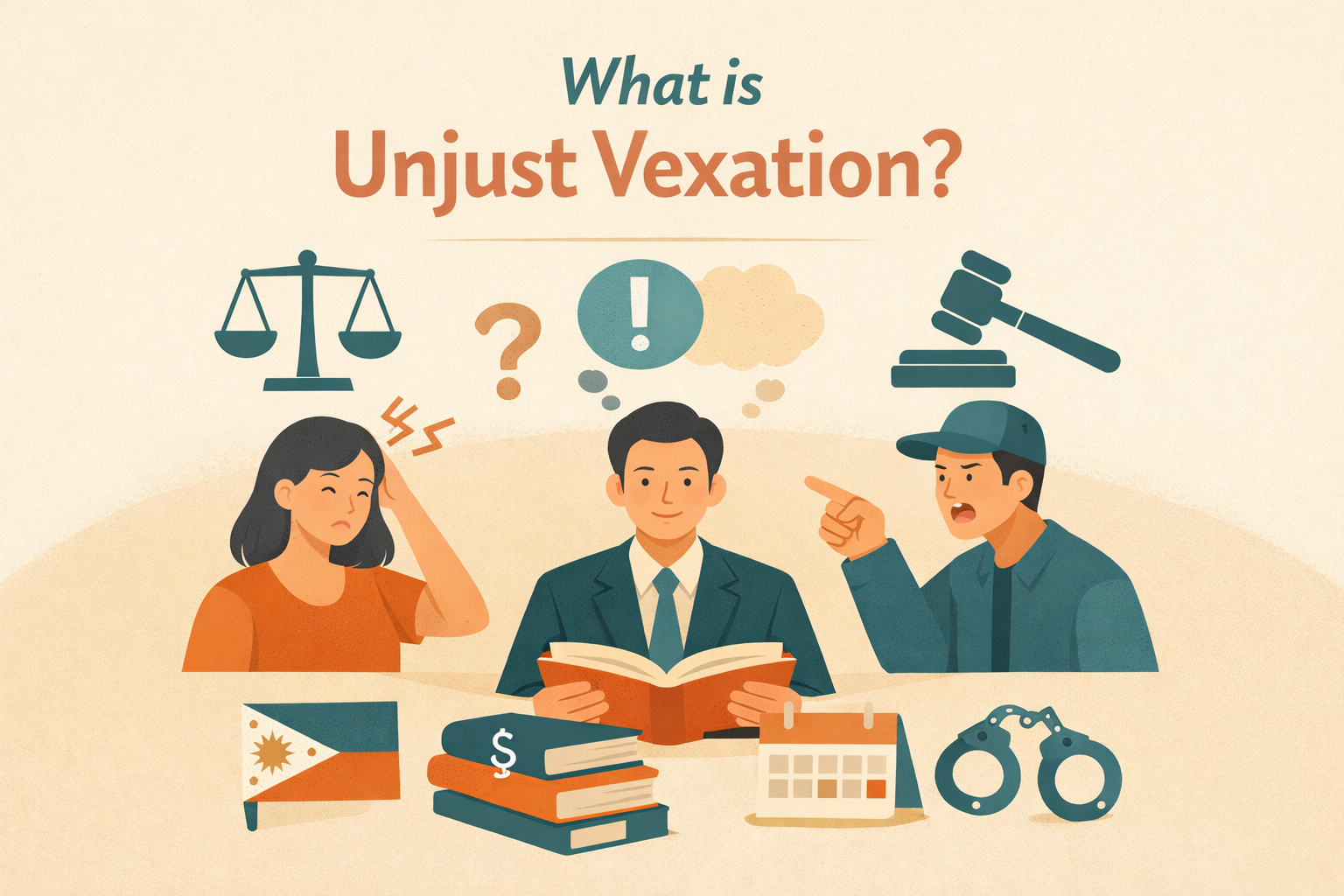
Clients often use the phrase “unjust vexation” to describe any situation where they feel harassed, annoyed, or disturbed. In Philippine criminal law, however, unjust vexation is not just a general complaint. It is a specific light offense defined and punished under the Revised Penal Code, with clear legal elements that must be proven before a person can be held criminally liable.
This article explains what unjust vexation is, how courts define it, what must be proven, and when conduct goes beyond unjust vexation into a more serious crime.
Legal Basis: Article 287 of the Revised Penal Code
Unjust vexation falls under Article 287 of the Revised Penal Code, which penalizes “any other coercions or unjust vexations.” The law provides that:
“Any other coercions or unjust vexations shall be punished by arresto menor or a fine ranging from five to two hundred pesos, or both.”
Although the penalty is relatively light, the offense still carries a criminal record and court proceedings, which can have serious personal and professional consequences.
How the Supreme Court Defines Unjust Vexation
The Supreme Court has described unjust vexation as a broad, catch-all offense. It covers acts that may not cause physical injury or financial loss, but unjustifiably annoy, irritate, torment, or disturb another person’s peace of mind.
In Maderazo v. People (2006), the Court emphasized that the focus is not on physical harm, but on the effect on the victim’s mind. The key question is whether the act caused mental disturbance such as annoyance, irritation, or distress.
The Court also clarified an important point: unjust vexation is a felony by dolo, meaning it requires malice or intent. Because of this, good faith can be a valid defense. If a person honestly believed they had a right or authority to act, and did not intend to annoy or harass, criminal liability may not attach.
The Elements of Unjust Vexation
To secure a conviction for unjust vexation, the prosecution generally must prove the following:
There was an act directed at the victim.
The act does not need to be violent or physically restraining. It can be verbal, written, or behavioral.The act caused mental disturbance.
This can take the form of annoyance, irritation, torment, distress, or emotional disturbance.The act was unjustified and malicious.
The offender must have acted without lawful authority, right, or reasonable excuse, and with intent to annoy or harass.
Because malice is required, honest mistake or good faith may negate criminal liability. This is especially relevant in disputes involving property, debts, or supposed rights, where one party claims they were merely “enforcing” what they believed was legally theirs.
Examples of Acts Considered Unjust Vexation
Philippine jurisprudence shows how flexible the concept of unjust vexation can be.
1. Unwanted Physical Advances
In People v. Sumingwa (2009), acts such as unwanted public embracing, dragging, and kissing that caused annoyance and emotional disturbance to the victim were treated as falling under the concept of unjust vexation.
2. Harassing or Disturbing Conduct
Courts have ruled that even without physical harm or restraint, persistent or unjustified conduct that disturbs a person’s peace of mind may qualify as unjust vexation. The Information filed in court does not even need to spell out malice in detail, as long as the facts show unjustified annoyance or distress.
3. Taking the Law Into One’s Own Hands
The Supreme Court has warned that a person cannot “take the law into his own hands.” Harassing or pressuring someone to enforce a supposed right, instead of going through proper legal channels, may amount to unjust vexation if it causes mental disturbance.
When It Is Not “Just” Unjust Vexation
Not all annoying or disturbing acts are charged as unjust vexation. If the conduct falls under a more specific or more serious crime, that crime will apply instead.
For example, in De Vera v. People (2021), the Supreme Court ruled that sexually explicit acts in the presence of a minor were not mere unjust vexation. Because of their sexual nature and traumatic impact, they were punishable under R.A. 7610 (Special Protection of Children Against Abuse, Exploitation and Discrimination Act).
This shows that unjust vexation is often used only when the act does not squarely fall under another defined offense such as acts of lasciviousness, grave coercion, or child abuse.
Practical Perspective: Why This Matters
Unjust vexation is commonly filed in neighbor disputes, workplace conflicts, online harassment, and personal altercations. Because the standard focuses on mental disturbance and unjustified conduct, the line between criminal behavior and ordinary disagreement can be thin.
If you believe you are being harassed, documenting how the acts affect you emotionally and mentally can be critical. On the other hand, if you are accused, showing that you acted in good faith or under a legitimate belief of right can be a strong defense.
Conclusion
Unjust vexation under Philippine law is a light but real criminal offense designed to protect a person’s peace of mind from unjustified annoyance, harassment, or disturbance. It does not require physical injury or financial loss, but it does require malice and lack of lawful justification.
At its core, the law draws a boundary between legitimate assertion of rights and conduct that crosses into harassment. When in doubt, the safer course is always to resolve disputes through proper legal channels rather than personal pressure or self-help.
*This blog post is intended for informational and academic purposes only and does not constitute legal advice. Readers are encouraged to consult a qualified lawyer for advice specific to their individual circumstances.
Need a lawyer to help you with an unjust vexation case?
Contact us and set an appointment today. Our team is ready to guide you through every step with clarity, compassion, and legal precision.